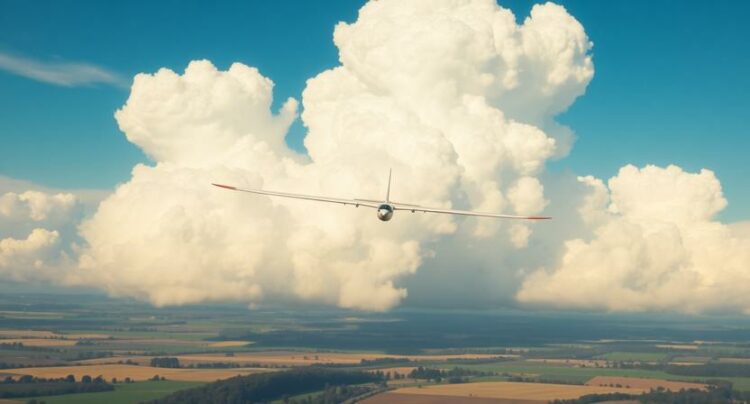
At first glance, glider flying seems impossible. With no engine producing thrust, many people wonder how these sleek aircraft remain airborne for long periods or even travel hundreds of miles. Yet skilled soaring pilots regularly stay in the air for hours, climb thousands of feet, and cross entire states using nothing but the atmosphere itself.
The answer lies in nature’s invisible energy sources. Rising warm air, mountain winds, ridge lift, and atmospheric convection currents allow gliders to gain altitude and continue flying without an engine. Over decades, pilots have mastered the science of reading weather patterns and understanding how the sky behaves.
For anyone asking how do gliders fly without an engine, the explanation combines physics, meteorology, and pilot skill. Soaring is not simply passive flight. It is an active process of finding and using rising air efficiently.
What Makes Glider Flight Different From Powered Flight
The biggest difference between soaring vs flying powered aircraft is propulsion. Airplanes with engines generate continuous thrust, allowing them to climb whenever fuel and power are available. Gliders, on the other hand, rely entirely on atmospheric lift after launch.
A glider is designed with long, narrow wings that create exceptional aerodynamic efficiency. These wings allow the aircraft to lose altitude very slowly while moving forward. Instead of using fuel to climb, glider pilots search for naturally rising air masses that lift the aircraft upward.
This is why soaring pilots often describe the sky as a landscape filled with invisible currents, waves, and rivers of air.
The Federal Aviation Administration explains that gliders are capable of extended flight because of their highly efficient wing design and the use of atmospheric lift sources. Federal Aviation Administration Glider Handbook
How Do Gliders Stay in the Air?
To understand how do gliders stay in the air, it helps to look at the four basic aerodynamic forces affecting every aircraft:
Lift
Lift is created when air flows over and under the wings. The shape of the wing causes pressure differences that pull the aircraft upward.
Weight
Gravity constantly pulls the glider downward.
Drag
Air resistance slows the aircraft during flight.
Forward Motion
Even without an engine, a glider continues moving forward because gravity pulls it downward at a shallow angle. As it descends, airflow across the wings continues generating lift.
A glider is always slowly descending unless it encounters rising air. The key to soaring is finding air that rises faster than the glider sinks.
What Is Thermal Soaring?
One of the most important concepts in soaring flight is thermal soaring.
So what is thermal soaring exactly?
Thermal soaring is the process of using columns of rising warm air, called thermals, to gain altitude. These thermals form when the sun heats the Earth unevenly.
Dark surfaces such as asphalt parking lots, plowed fields, rocky terrain, and dry ground absorb more heat than forests or lakes. The warm air above these surfaces rises upward in columns, similar to bubbles in boiling water.
Glider pilots circle inside these rising columns to climb higher.
How Thermals Form
The process begins with solar heating:
- The sun warms the ground.
- The ground heats nearby air.
- The warmer air becomes less dense.
- The warm air rises upward through cooler surrounding air.
- A thermal develops.
These thermals can extend thousands of feet into the atmosphere.
On good soaring days, pilots may climb several hundred feet per minute without using any engine power.
The National Weather Service explains that atmospheric convection occurs when warm air rises and cooler air sinks, creating vertical air movement that can support thermal development. National Weather Service on Convection
How Have Glider Pilots Learned to Use Convection Currents?
The history of soaring is deeply connected to understanding convection currents and weather behavior.
Early glider pilots noticed birds circling without flapping their wings. Hawks, vultures, and eagles instinctively use thermals to remain airborne. Human pilots eventually copied these techniques.
Over time, soaring pilots developed methods to identify where thermals were likely to form.
Reading the Ground
Pilots study terrain carefully because certain surfaces generate stronger thermals:
Dark Fields
Dark soil absorbs sunlight quickly and heats surrounding air efficiently.
Rocky Areas
Rock retains heat and often produces strong rising air later in the day.
Urban Areas
Parking lots and buildings can create powerful thermals because concrete and asphalt absorb heat rapidly.
Dry Terrain
Dry ground usually produces better thermals than moist vegetation or lakes.
Reading the Sky
Clouds often reveal where rising air exists.
Cumulus Clouds
Puffy cumulus clouds frequently form at the tops of thermals. Pilots may fly from one cloud to another while remaining in rising air.
Cloud Streets
Long rows of clouds indicate organized lift patterns caused by wind and convection alignment.
Birds
Birds circling without wing movement can signal a thermal directly below.
This accumulated knowledge explains how have glider pilots learned to use convection currents so effectively over the decades.
How Do Gliders Gain Altitude?
Many people assume gliders only descend slowly, but soaring pilots routinely climb thousands of feet.
So how do gliders gain altitude?
The answer depends on finding air that rises faster than the aircraft sinks.
Circling Inside Thermals
When a pilot encounters rising air, they bank into a turn and circle tightly within the thermal column.
Inside the thermal:
- Rising air lifts the glider upward
- The pilot maintains efficient turning speed
- Instruments help center the strongest lift
As long as the thermal rises faster than the glider descends naturally, the aircraft gains altitude.
Variometers
A key glider instrument is the variometer.
This device measures vertical speed and tells pilots whether they are climbing or sinking. Experienced soaring pilots constantly monitor variometer readings to locate the strongest lift.
The FAA Glider Flying Handbook describes how variometers assist pilots in detecting and centering thermals during soaring flight. FAA Glider Flying Handbook PDF
Ridge Lift and Mountain Updrafts
Thermals are not the only source of lift.
When wind strikes a mountain or ridge, the air is forced upward along the slope. This creates ridge lift.
Gliders can remain airborne for hours by flying parallel to mountain ridges where rising air continues lifting the aircraft.
How Ridge Soaring Works
- Wind blows toward a ridge or mountain.
- The terrain forces the air upward.
- Gliders fly within this rising air zone.
- Continuous lift allows sustained flight.
Ridge soaring is common in mountainous areas and coastal cliffs.
Strong ridge lift can allow pilots to travel long distances while maintaining altitude.
Wave Soaring: Climbing Into the Stratosphere
One of the most extraordinary forms of soaring involves mountain waves.
When stable air flows over mountain ranges, standing waves can form far downwind. These waves may extend to extremely high altitudes.
Wave soaring has allowed glider pilots to reach altitudes above 50,000 feet.
Lenticular Clouds
Smooth, lens-shaped lenticular clouds often indicate mountain wave activity. These clouds appear stationary even in strong winds.
Pilots trained in wave soaring can ride these atmospheric waves like surfers riding ocean swells.
NASA has studied mountain wave systems extensively because of their impact on aviation and atmospheric science. NASA Mountain Wave Research
The Science Behind Soaring Efficiency
Glider performance depends heavily on aerodynamic efficiency.
Glide Ratio
A glide ratio measures how far a glider travels horizontally compared to altitude lost.
For example:
- A 40:1 glide ratio means the aircraft travels 40 miles forward for every mile of altitude lost.
- High-performance sailplanes may exceed 60:1 ratios.
This efficiency allows gliders to travel enormous distances between thermals.
Wing Design
Modern gliders feature:
- Long wingspans
- Smooth aerodynamic surfaces
- Lightweight composite materials
- Minimal drag
These features maximize lift while reducing sink rate.
Why Weather Knowledge Is Critical
Weather understanding is essential in soaring flight.
Glider pilots constantly analyze:
- Wind direction
- Temperature changes
- Cloud formation
- Atmospheric stability
- Humidity
- Terrain effects
A skilled soaring pilot is often as much meteorologist as aviator.
The National Oceanic and Atmospheric Administration provides educational resources on atmospheric lift, thermals, and convection processes that directly affect soaring conditions. NOAA Atmospheric Processes Overview
Cross-Country Soaring
Competitive and recreational glider pilots frequently fly cross-country routes spanning hundreds of miles.
Leapfrogging Between Thermals
Pilots climb high in one thermal, glide toward another likely lift source, then climb again.
This repeating cycle allows long-distance travel without any engine power.
Energy Management
Successful soaring requires careful energy management:
- Flying too slowly increases stall risk
- Flying too fast wastes altitude
- Leaving thermals too early may prevent reaching the next lift source
Pilots continuously calculate speed, altitude, wind, and distance during flight.
How Long Can a Glider Stay Aloft?
Under strong soaring conditions, gliders can remain airborne for remarkably long periods.
Some flights last:
- Several hours recreationally
- Entire days in competition
- More than 1,000 miles in cross-country attempts
The duration depends on weather conditions, pilot skill, and available lift sources.
Without rising air, even the best glider eventually descends and lands.
The Human Skill Behind Soaring
Technology helps modern glider pilots, but soaring remains highly dependent on human judgment and observation.
Experienced pilots learn to sense:
- Small wing movements
- Subtle turbulence
- Changes in climb rate
- Visual cloud patterns
- Wind drift
- Thermal structure
Every soaring flight becomes a dynamic puzzle involving atmosphere, terrain, timing, and decision-making.
Why Soaring Continues to Fascinate Pilots
For many aviators, soaring represents the purest form of flight.
Without engine noise or fuel consumption, pilots connect directly with atmospheric forces. Every climb comes from understanding nature rather than mechanical power.
The challenge of reading invisible air currents and staying airborne using only natural energy is what makes gliding uniquely rewarding.
For anyone wondering how do gliders fly without an engine, the answer is both scientific and deeply human. Glider pilots use convection currents, thermals, ridge lift, and atmospheric waves to transform sinking flight into sustained soaring. Through weather knowledge, aerodynamic efficiency, and refined skill, they turn the sky itself into a source of energy.
That combination of science, strategy, and freedom is what keeps soaring one of aviation’s most remarkable disciplines.
Related Posts: Glider Adventures: Breathtaking Scenic Routes You Can Only See from the Sky